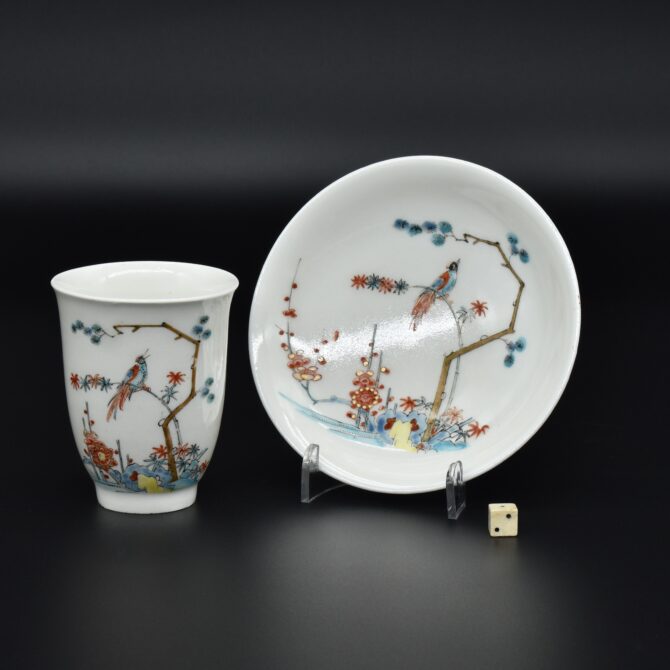
An Early 18th Century Meissen Beaker and Saucer with Kakiemon Style Enamels.
The Meissen Porcelain c.1715-1720, the Dutch Enamels in the Kakiemon Style c.1720-1730.
An Early 18th Century Meissen Beaker and Saucer with Dutch Decorated Kakiemon Style Enamels, the Meissen Porcelain c.1715-1720, the Dutch Enamels in the Kakiemon Style c.1720-1730. The enamel palette employed on this early Meissen porcelain beaker and saucer is rather close to the Japanese Kakiemon original, it is perhaps more closely aligned to the painting and palette of the Meissen factory. These overglazed enamels were not used at Meissen in the period of 1715 to 1720. However, the enamels closely resemble those found on Chinese export porcelain decorated in the Netherlands of the period c.1720-1730. The Japanese Hō-ō bird is type of auspicious phoenix and is similar to the Chinese Fenghuang. the Hō-ō appears only in peaceful and prosperous times (nesting, it is said, in paulownia trees), and hides itself when there is trouble. As the herald of a new age, the Hō-ō descends from heaven to earth to do good deeds, and then it returns to its celestial abode to await a new era. It is both a symbol of peace (when the bird appears) and a symbol of disharmony (when the bird disappears). The Hō-ō Bird appears frequently in Japanese porcelain of the late 17th and early 18th centuries, especially in Kakiemon wares. Ho-Ho is often used when referring to English porcelain versions of these Kakiemon designs. This early Meissen beaker and saucer has a very feint yellow-green tinge to the glaze, it doesn't have the brilliant white look of slightly later Meissen porcelain.
For a closely related teabowl and saucer click on the link to the Victoria & Albert Museum website Meissen tea bowl and saucer
The Rudolphe Lamaire Plot :
Meissen porcelain painted in the Netherlands... "may have been part of an infamous scheme to dupe wealthy clients into buying imitations of Japanese porcelains which were very expensive and only imported in small numbers. The plot centred on a French merchant named Lemaire who was spurred on by the demand for Kakiemon porcelain in Paris. He purchased undecorated Meissen porcelain from the factory warehouse in Dresden in 1728-29, and sent it to be decorated in Holland 'in the taste of old Japan'. He chose Dutch decorators as they were skilled at working on plain white Chinese porcelains and, of course, on their own homegrown earthenwares made in Delft. He arranged for the Meissen pieces he bought not to have the usual underglaze crossed sword marks applied to their bases, or to have the mark applied overglaze so that it could easily be ground off. Luckily the plot was discovered in 1731, by which time the Meissen factory was catering to the fashion for exotic porcelain by decorating its own wares with convincing Japanese designs, copied from authentic Japanese pieces in the Saxon royal collection." (From the Victoria & Albert Museum website)."
New Research :
I am much indebted to Dr.Nicholas Zumbulyadis the new information regards related pieces with the blue enamel cross-swords mark. I find this research really fascinating, to get an entirely new perspective is of course enlightening but also very exciting. Science is leading the way with understanding enamel decoration
See Below For More Photographs and Information.
View details
From Dr. Nicholas Zumbulyadis "We have published the XRF spectra of the beaker you sold me that is also depicted at the bottom of your most recent website update. Yes, there are some differences in the colorants used, particularly green and yellow. However, I just finally completed transcribing the ENTIRE book of recipes handwritten by Höroldt and kept in the Meissen Manufactory archives. A full 30% of the recipes were developed by Höroldt specifically for imitating the Kakiemon palette which Höroldt calls “altjapanisch.” He explicitly writes that he uses these recipes only when he paints in the old Japanese style.The composition expected on the basis of these particular recipes corresponds exactly to the XRF spectra we obtained from that beaker and other pieces with Japanese Palace inventory numbers. Those numbers were assigned after the confiscation of the items from Count Hoym’s palace in 1731 when he was arrested for colluding with Lemaire. Again I don’t think Hoym would be hoarding Dutch decorated pieces.
Lemaire did send some pieces to Holland initially but was not satisfied with the results. I also don’t think one can apply enamel swords, fire, export and then have the piece redecorated and fired again especially if the design also contains blue enamels. I suspect that under such conditions, the enamel swords would flow again and become less crisp. In the confiscated pieces that found their way to the Japanese Palace the enamel swords are quite crisp. Remember this is overglaze blue, unlike underglaze blue where the cobalt oxide reacts with the porcelain body to form a chemically different much more stable cobalt pigment known today as Thenard’s Blue (Thenard unbeknownst to him really merely rediscovered this pigment, it has been identified on old Egyptian ceramics).
Note that in the September 30, 1729 agreement between Lemaire and the Meissen Manufactory Lemaire agreed not to have the white ware decorated outside the manufactory (Weber essay p.43 (pdf p. 3) r.h.s. bottom). The reference to Dr.Nicholas Zumbulyadis Archaeometry paper where we published the XRF study is:
Dr.Nicholas Zumbulyadis, Erich Uffelman, Ron Fuchs II, “Scandal at the Albrechtsburg: The Hoym–Lemaire affair and its impact on the early 18th-century development of pigment technology at the Meissen Manufactory,” Archaeometry, 66(2024): 1313–1327.
-
Oriental & European CeramicsEstablished in 1980
 ALL ITEMS FOR SALE
 -
 CHINESE CERAMICS
 -
 JAPANESE and OTHER CERAMICS
 -
 Recently Added
 -
 Sold Archive
Buying Antique Ceramics From Robert McPherson Antiques
Read more
New Items
-
-
-
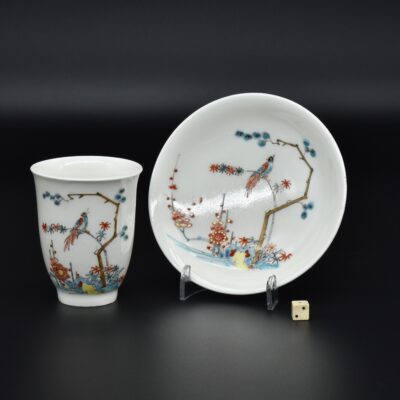 An Early 18th Century Meissen Beaker and Saucer with Kakiemon Style Enamels.The Meissen Porcelain c.1715-1720, the Dutch Enamels in the Kakiemon Style c.1720-1730.
 -
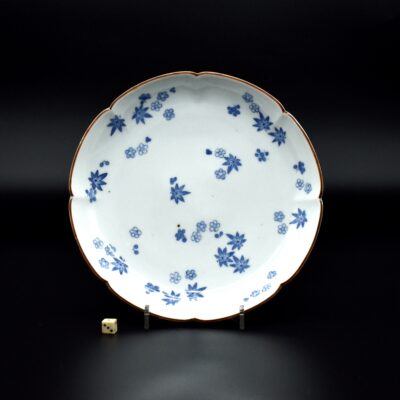 A 17th Century Japanese Blue and White Kakiemon Dish.c.1670 - 1690.
Robert McPherson Antiques
Specialist in Oriental Ceramics
WELCOME TO OUR WEBSITE We hope you find it easy to navigate and enjoy looking at what we have on offer. As well as the objetcs we have for sale, we offer a selection of scholary pages to inform you about the different subjects concerning Oriental Ceramics. We pride ourselves on offering genuine pieces of rare and unusual Chinese and Japanese porcelain and pottery. Everything we sell is guaranteed to be in the condition we describe it as on the website and on the invoice. If you have any questions please get in contact with us. We also have a mailing list that you can subscribe to. You will receive a newsletter when the website is updated. Regards, Robert McPherson.
About us