R & G McPHERSON ANTIQUES


Polychrome

Monochrome

Blue and White

Early Chinese

South-East Asian
and Japanese

European Ceramics

Shipwreck Ceramics
SEARCH
 

'EUROPEAN CERAMICS'
Will be Updated Thursday MAY 15th 2008.

R & G McPHERSON ANTIQUES :
'SUMMER EXHIBITION'. JUNE 4th - 14th 2008.
Including Chinese and Japanese Ceramics from The John Drew Collection Part II.
See 'Events' for Details.
Photographs are being added to the website

FREE BOOKS ABOUT EARLY CHINESE CERAMICS : SEE
'EARLY CHINESE'.

TO BE INFORMED OF NEW ADDITIONS TO OUR WEBSITE PLEASE SUBSCRIBE USING THE 'EMAIL-SUBSCRIBE' BUTTON BELOW.

     British Antique Dealers Association 40 Kensington Church Street
London W8 4BX

Tel: 00 44 (0)20 7937 0812
EMAIL -SUBSCRIBE
Kensington Church Street Antique Dealers Association

TO BE INFORMED OF NEW ADDITIONS TO OUR WEBSITE PLEASE SUBSCRIBE USING THE 'EMAIL-SUBSCRIBE' BUTTON ABOVE.
YOU WILL RECEIVE AN EMAIL WITHIN AN HOUR OF THE WEBSITE BEING UPDATED.


QIANLONG 1736 - 1795. stock n.  19619
QIANLONG 1736 - 1795.A Chinese Export Porcelain Famille Rose Armorial Buttertub and Cover c.1785.

This piece was produced right at the end of main production of Chinese export to England and Europe. Decorated in a sparse Neo-Classical style with an unidentified coat of arms with the motto 'Per ardua ad astra'. This is mentioned in Howard as being the motto for two families, one of which does not have this coat of arms. The other is unillustrated but is said to be the Stibbert family.
Provenance :
From a English Private Collection. R and G McPherson dealers in antique Chinese porcelain
KANGXI (1662 - 1722).  康熙 stock n.  16504
KANGXI (1662 - 1722). 康熙Chinese Blue and White Porcelain Censor Decorated with the "Antiques" design.This censor dates from the end of the Kangxi Period c.1700 to 1720. It is of a larger size than is normal and it is therefore rather heavy. The 'Antiques Pattern' is in fact a group of related designs with scholar's objects and precious objects.Some times they give the impression of a still life. R and G McPherson dealers in antique Chinese porcelain
KANGXI 1662- 1722. Decorated in London c.1700-1720. stock n.  19404
KANGXI 1662- 1722. Decorated in London c.1700-1720.A Fine and Rare London Decorated Kangxi Blanc de Chine Porcelain Chocolate Pot. Decorated with Chinese Figures One of which, the Sower, is from Athanasius Kircher's 'Description of China', that was published together with John Ogilby's English Translation of Nieuhof's 'Embassy to China' in 1669 (H.Espir).
The bronze mounts are 18th century..

Provenance :
Dr Bernard Watney.
The Watney Collection of Chinese Porcelain Decorated in Holland and England. Bonham's, New Bond street, London 7th November 2003. Lot 6 Illustrated on page 14.
E and H Manners, Kensington Church Street.
Mr Alan Green.

Exhibited : The British Museum 'East Meets West' Exhibition. Over Decorated Porcelain (1 October 2001 to 20 May 2002).

Illustrated : European Decoration on Oriental Porcelain 1700 - 1830 (Helen Espir, Jorge Welsh Books, 2005) 214 Full page illustration. Pages 211 and 215.

Published : The English decoration of Oriental Porcelain : some overlooked groups 1700-1750. A paper read by Errol Manners at the Courtauld Institute on 18th October 2003. Item 22.

R and G McPherson dealers in antique Chinese porcelain
KANGXI c.1710 - 1715. stock n.  19313
KANGXI c.1710 - 1715.A Rare Kangxi Blue and White Porcelain Plate in Imitation of English or Dutch Delftware. Decorated with European Figures in a Landscape with 'Sponged' Trees.

For a very similar Kangxi Porcelain plate see : The Choice of the Private Trader, The Private Market in Chinese Export Porcelain illustrated from the Hodroff Collection ((David S. Howard, Zwemmer,1994).

David Howard states ...."although the original could be Dutch delftware ; a scene with very similar trees and eccesiatical and other buildings but with four figures was sold at Phillips, London in 1980 as 'probably Lambeth c.1700-1710'. Such an original would have been taken to China for copying - probably for the Private Trade". .

To be Offered for Sale at :
R & G McPHERSON ANTIQUES 'SUMMER EXHIBITION'
Including Chinese and Japanese Ceramics from The John Drew Collection Part II.
JUNE 4th - 14th 2008.
See 'Events' for Details. R and G McPherson dealers in antique Chinese porcelain
WANLI 1573 - 1620 <BR>
Ming Dynasty 明代 stock n.  19378
WANLI 1573 - 1620
Ming Dynasty 明代A Wanli Blue and White Porcelain Bowl c.1580-1600. The Well Decorated with a Crane, the Border with 'Ruyi' Panels with Lotus Petals Interspersed with Jeweled Tassels. The Exterior Plain.

Bowls of this type with blue and white decoration used on the inside were sometimes decorated with 'Kindrande' colours.'Kinrande' (meaning Gilt Brocade Design) Uses Green Enamel, Iron Red Pigment and Finished with Gilding. For Examples of Kinrande Ming Porcelain See : Chinese Ceramics From Japanese Collections, Tang Through Ming Dynasties (Asia House Gallery,U.S.A,1977) Pages 92 - 99. Kinrande was a New Colour Scheme used During the Jiajing and Wanli Periods.

Provenance : The Loose Family Collection of South East Asian Ceramics. Formed by Reidun and Ivar Loose and partly exhibited at Verstlandske Kunstindustrimuseum, Bergen, Norway and at The Rohsska Museum, Gothenberg Sweden, 1973. Formed in Djakarta between the late 1950's and 1970. Marked 7-31 and 6A6229 to the base. R and G McPherson dealers in antique Chinese porcelain
YONGZHENG or Early QIANLONG c.1730 - 1750 stock n.  19620
YONGZHENG or Early QIANLONG c.1730 - 1750A Fine and Rare Chinese Export Porcelain Armorial 'En Grisaille' Teabowl and Saucer for the Viennese Market, Yongzheng or Early Qianlong c.1730-1750.

Potted to a semi-eggshell thinness, this Chinese Export Porcelain teabowl and saucer is extremely finley painted in black line with a large coat of arms, intricate borders and three large sprays of flowers. The back has a large cypher.
The arms are those of the Paverfeind family of Vienna and are illustrated in 'Armorial General' Volume II by J.B. Rietstrap page 395.

Provenance :
A.V. & M.R. Santos London.(with a letter stating the coat of arms)
An English Private Collection Purchased before 20th January 1986. R and G McPherson dealers in antique Chinese porcelain
HATCHER CARGO c.1643<BR>
(Transitional Period : Late Ming or Early Qing).  stock n.  19489
HATCHER CARGO c.1643
(Transitional Period : Late Ming or Early Qing). A Pair of Hatcher Cargo Dishes Decorated with Horses Flying Over Waves.

THE HATCHER CARGO, Of the 25,000 recovered pieces most were blue and white porcelain from Jingdezhen. However, a few Swatow and Blanc de Chine items were also recovered. It seems apparent that this cargo was going to be trans-shipped, some for the local South East Asian market, including bird feeders, cricket cages and pickled dishes. However there were many items made for the West, including western shapes. The Dutch East India Company ( The V.O.C.) had been sending wooden shapes out for copying from the 1630’s.Transitional period porcelain (between the end of the Ming and the beginning of the Qing) is often of very good quality with wonderful landscape and paintings of plants. Indeed the quality of this cargo is generally very high. It dates from the very end of the Ming dynasty. A cover with a cyclical date of Sring 1643 has been recovered. It is one of the most important shipwrecks recovered (See 'HISTORY' for more information about the Hatcher Cargo and 'READING LIST' for books about shipwreck ceramics).

Provenance : The John Drew Collection of Chinese and Japanese Ceramics.

To be Offered for Sale at :
R & G McPHERSON ANTIQUES 'SUMMER EXHIBITION'
Including Chinese and Japanese Ceramics from The John Drew Collection Part II.
JUNE 4th - 14th 2008.
See 'Events' for Details. R and G McPherson dealers in antique Chinese porcelain
WANLI 1573 - 1620 <BR>
Ming Dynasty. 萬曆 明代 stock n.  19500
WANLI 1573 - 1620
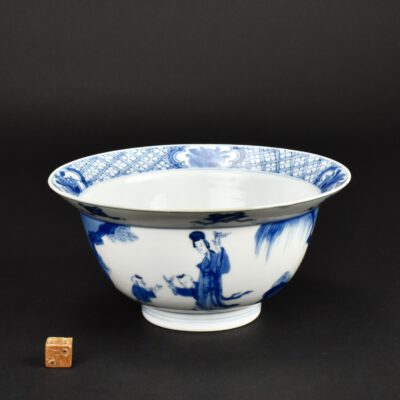
Ming Dynasty. 萬曆 明代A Late Ming Blue and White Porcelain Bowl Decorated with Boys, Wanli 1573-1620, Xuande Four Character Mark.

For a Xuande marked Wanli blue and white stem cup with similar decoration See Marchant's Exhibition Catalogue : Ming Blue and White ; Jiajing - Chongzhen, Including Dated Examples (S. Marchant & Son,2004) Item 31.

Provenance : The John Drew Collection of Chinese and Japanese Ceramics.

To be Offered for Sale at :
R & G McPHERSON ANTIQUES
'SUMMER EXHIBITION'
Including Chinese and Japanese Ceramics from The John Drew Collection Part II.
JUNE 4th - 14th 2008.
See 'Events' for Details.

IF YOU WOULD LIKE EMAIL NOTIFICATION OF NEW STOCK ADDED TO THE WEBSITE GO TO THE HOME PAGE AND CLICK ON THE EMAIL/SUBSCRIBE BUTTON. R and G McPherson dealers in antique Chinese porcelain
YONGZHENG 1723 - 1735 stock n.  19512
YONGZHENG 1723 - 1735A Yongzheng Semi-Eggshell Teabowl and Saucer Decorated in Iron Red and Gilding with Pheonix.

Provenance : The John Drew Collection of Chinese and Japanese Ceramics.

To be Offered for Sale at :
R & G McPHERSON ANTIQUES 'SUMMER EXHIBITION'
Including Chinese and Japanese Ceramics from The John Drew Collection Part II.
JUNE 4th - 14th 2008.
See 'Events' for Details. R and G McPherson dealers in antique Chinese porcelain
KANGXI 1662 - 1722 stock n.  19539
KANGXI 1662 - 1722A Pair of Blue and White Kangxi Porcelain Dishes with Chenghua Marks (Ming Dynasty 1465-1487).

Provenance : The John Drew Collection of Chinese and Japanese Ceramics.

To be Offered for Sale at :
R & G McPHERSON ANTIQUES 'SUMMER EXHIBITION'
Including Chinese and Japanese Ceramics from The John Drew Collection Part II.
JUNE 4th - 14th 2008.
See 'Events' for Details. R and G McPherson dealers in antique Chinese porcelain
QIANLONG 1723 - 1735. stock n.  19534
QIANLONG 1723 - 1735.A Pair Qianlong Porcelain Dishes, Qianlong Seal Mark and of the Period.

Painted with the 'Three Friends of Winter'.

Provenance : The John Drew Collection of Chinese and Japanese Ceramics.

To be Offered for Sale at :
R & G McPHERSON ANTIQUES 'SUMMER EXHIBITION'
Including Chinese and Japanese Ceramics from The John Drew Collection Part II.
JUNE 4th - 14th 2008.
See 'Events' for Details. R and G McPherson dealers in antique Chinese porcelain
KANGXI 1662 - 1722<BR>
Qing Dynasty stock n.  19469
KANGXI 1662 - 1722
Qing DynastyA Miniature Chinese Export Porcelain Blue and White Teabowl and Saucer, Kangxi c.1690-1710. Decorated with fish swimming among water weed. The base marked with the character for Jade

Provenance : The John Drew Collection of Chinese and Japanese Ceramics.

To be Offered for Sale at :
R & G McPHERSON ANTIQUES 'SUMMER EXHIBITION'
Including Chinese and Japanese Ceramics from The John Drew Collection Part II.
JUNE 4th - 14th 2008.
See 'Events' for Details. R and G McPherson dealers in antique Chinese porcelain
NORTHERN SONG 960 - 1127 stock n.  19515
NORTHERN SONG 960 - 1127A Northern Song Ding Ware Dish of Flower Shape, Hebei Kilns, 10th Century.

For a Ding Ware dish of this form see : Chinese Ceramics, The New Standard Guide (Hi Li, Thames and Hudson,1996.ISBN 0-500-23727-1). Page148 Item 219.

Provenance : The John Drew Collection of Chinese and Japanese Ceramics.

To be Offered for Sale at :
R & G McPHERSON ANTIQUES
'SUMMER EXHIBITION'
Including Chinese and Japanese Ceramics from The John Drew Collection Part II.
JUNE 4th - 14th 2008.
See 'Events' for Details. R and G McPherson dealers in antique Chinese porcelain
CHINESE 19th Century stock n.  19499
CHINESE 19th CenturyA 19th Century Chinese Blue and White Porcelain Snuff Bottle Decorated with Birds.

Provenance : The John Drew Collection of Chinese and Japanese Ceramics.

To be Offered for Sale at :
R & G McPHERSON ANTIQUES 'SUMMER EXHIBITION'
Including Chinese and Japanese Ceramics from The John Drew Collection Part II.
JUNE 4th - 14th 2008.
See 'Events' for Details. R and G McPherson dealers in antique Chinese porcelain
VIETNAMESE c.1450 - 1520. stock n.  19533
VIETNAMESE c.1450 - 1520.A Unusual Vietnamese Blue and White Pottery Crab Form Box and Cover.

For a very similar blue and white crab box and cover from the Ulrich Beck collection see : Vietnamese Ceramics, A Separate Tradition (John Stevenson and John Guy, Art Media Resources,1997.ISBN 1-878529-22-6) Page 367 Item 358

Provenance :
The Mr and Mrs Robert P.Piccus Collection of Annamese Ceramics (label inside the base).
An English Private Collection.
The John Drew Collection of Chinese and Japanese Ceramics.

To be Offered for Sale at :
R & G McPHERSON ANTIQUES 'SUMMER EXHIBITION'
Including Chinese and Japanese Ceramics from The John Drew Collection Part II.
JUNE 4th - 14th 2008.
See 'Events' for Details. R and G McPherson dealers in antique Chinese porcelain
QIANLONG. c.1750 - 1770. 乾隆 stock n.  17647
QIANLONG. c.1750 - 1770. 乾隆A Chinese Export Porcelain Famille Rose Group. Qianlong (1736-1795). Representing Liu Hai and an Acolyte. The Chinese Immortal Liu Hai is Shown Tempting a Three-Legged Toad with a String of Five Gold Cash. Such Brightly Enamelled Groups, often laden with Meaning to the Chinese, were Made Purely for Export to Europe, where their Meaning would have been Lost. For More information about Liu Hai Click on the Image. R and G McPherson dealers in antique Chinese porcelain
ARITA. Japanese c.1660 - 1670. stock n.  19186
ARITA. Japanese c.1660 - 1670.A Rare Early Japanese Arita Porcelain Dish in the Chinese Transitional Porcelain Style. Decorated with Two Figures in a Landscape. R and G McPherson dealers in antique Chinese porcelain
KANGXI 1662 - 1722. stock n.  19243
KANGXI 1662 - 1722.An Unusual Kangxi Porcelain Dish c.1700. Decorated in Blue and White with a Crucifixion Scene.

Christ on the cross is flanked by two figures representing the Virgin Mary and St.John. The technique of cross-hatched lines betrays the designs European origin, this scene would have been taken from a European copper-plate engraving of the period.

Provenance : Duveen Liverpool. ( Partial black wax seal to the reverse ) R and G McPherson dealers in antique Chinese porcelain
QIANLONG 1736 - 1795. stock n.  19623
QIANLONG 1736 - 1795.A Chinese Export Porcelain Famille Rose Armorial Teapot c.1765.

Decorated on either side with a complex armorial devise in Famille Rose enamels with the arms of Jervis. The arms, according to Howard, are Jervis of Darlaston in Staffordshire, Swinfen of Swynfen, Ward of Kent, Impey of Essex, and Wade of Ilford and Kilnsey in Yorkshire.

For a Chinese Export Porcelain jug of this design see : Chinese Armorial Porcelain (David Sanctury Howard,Faber and Faber,1974) Page 469 Item P17.

Provenance :
Heirloom and Howard Limited, Hay Hill, London. Purchased 1st July 1986, £ 750 (offered for sale with the original invoice).
Private English Collection. R and G McPherson dealers in antique Chinese porcelain
KANGXI 1662 - 1722. stock n.  19751
KANGXI 1662 - 1722.A Kangxi Famille Verte Biscuit Porcelain Model of a Parrot on a Rockwork Base.

Chinese Export Porcelain birds were normally sold as pairs originally. R and G McPherson dealers in antique Chinese porcelain
KANGXI 1662 - 1722. stock n.  19057
KANGXI 1662 - 1722.A Rare Kangxi Famille Verte Biscuit Porcelain 'Egg and Spinach' Low Miniature Table or Stand.

For a Kangxi 'egg and spinach demi-lune table see : The Copeland Collection, Chinese and Japanese Ceramic Figures (William Sergent, The Peabody Museum of Salem,1991) Pages 44 and 45 Item 11. William Sergent States "The actual function of these small tables is not fully understood. It is possible that these miniature tables were intended for the display of small objects on a merchant's desk".

Provenance: MRS. NELLIE IONIDES (1883 – 1962) Buxted Park, Sussex. Number painted in red to base of one leg.
Mrs. Nellie Ionides (1883 – 1962) Built up one of the finest collections of Kangxi porcelain of the first half of the 20th century. Famille Verte porcelain, and Famille Verte biscuit porcelain were a particular favourite, although she also collected furniture, paintings as well as Meissen porcelain. These were kept at her country estate at Buxted Park in Sussex. She purchased pieces from several great collectors and dealers, including John Pierpont Morgan, Edgar Gorer and Richard Bennett. Many of the pieces from her collection are depicted in the catalogues of these dealers and collectors published before 1935. R and G McPherson dealers in antique Chinese porcelain
HATCHER CARGO c.1643. ( Transitional Period : Late Ming or Early Qing ). stock n.  19283
HATCHER CARGO c.1643. ( Transitional Period : Late Ming or Early Qing ).Hatcher Cargo, Transitional Porcelain c.1643. A Hatcher Cargo Kraak Porcelain Blue and White Dish.
Label to Base : The Hatcher Collection Christie's Amsterdam 14-03-1984.

The Hatcher Cargo was the first shipwreck cargo to come on to the market. It was sold in three auctions in Christie's Amsterdam in 1984 and 1985. It is a very important cargo of shipwreck ceramics, despite the lack of historical evidence recorded by the salvage team. A porcelain cover dated to the Spring of 1643 helps confirm the date of the wreck. The Ming dynasty ended in 1644 and the period of chaos between between the end of the Ming and the beginning of the Qing dynasty is referred to as the Transitional period. The Hatcher Cargo is a vital dating tool for late Ming and early Qing porcelain.

The first known time Kraak was first used as a term to describe a type of late Ming blue and white porcelain was in 1673. This was over 100 years after what we now know as Kraak porcelain was first produced, however there is some evidence that it was a term that had been in use for some time. Blue and white porcelain was exported to Europe in large quantities from the mid 16th century. It was highly prized and the Portuguese fort hard against the Dutch to keep control of this lucrative trade, but in 1602 the Dutch sold the cargo they captured from the Portuguese Carrack 'San Tiago' and two years later they sold the cargo of the 'Santa Catarina'. These ships caused a sensation, it was the first time such large amounts of Chinese blue and white porcelain had been available in Northern Europe, many of the pieces were 'gifts' rather than to be sold on the open market .

For similar Hatcher Cargo Kraak porcelain dishes see : Fine And Important Late Ming And Transitional Porcelain, recently recovered from an Asian vessel in the South China Sea. Property of Captain Michael Hatcher. Christie's Amsterdam 14th March 1984. R and G McPherson dealers in antique Chinese porcelain
KANGXI 1662 - 1722. stock n.  19246
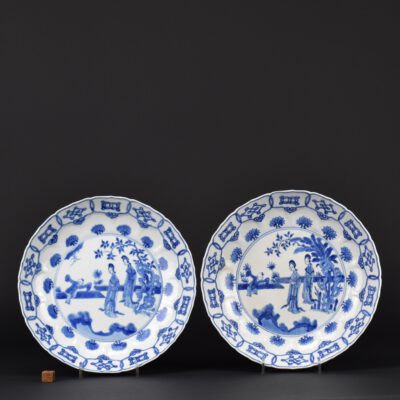
KANGXI 1662 - 1722.A Kangxi Blue and White Porcelain Barbed Rim Bowl. Decorated with Two pairs of Ladies in a Garden Landscape with Bamboo and Scholars Rocks. One Pair of Ladies Stand either Side of a Table with a Bonsai Tree in the Center. The One of the other Pair of ladies Facing Each other holds a 'Qin' (a stringed instrument). The Well of the Bowl is Painted with a Lohan.
The base is painted with a six character Chenghua mark (Ming 1465-1487). R and G McPherson dealers in antique Chinese porcelain
MING DYNASTY 1368 - 1644 stock n.  19492
MING DYNASTY 1368 - 1644A Ming Dynasty Celadon Dish, 15th Century.

Provenance :
Robert McPherson Antiques
The John Drew Collection of Chinese and Japanese Ceramics.

To be Offered for Sale at :
R & G McPHERSON ANTIQUES
'SUMMER EXHIBITION'
Including Chinese and Japanese Ceramics from The John Drew Collection Part II.
JUNE 4th - 14th 2008.
See 'Events' for Details. R and G McPherson dealers in antique Chinese porcelain
QIANLONG 1736 - 1795. stock n.  19571
QIANLONG 1736 - 1795.A Chinese Export Porcelain Teabowl Based on a Meissen Original, Qianlong c.1750 - 1760.

This small ogee moulded Chinese Export Porcelain teabowl is decorated in the Imari palette in a Chinese style used for export to the Middle East. The teabowl is however a copy of a Meissen original which could well have been exported to the Middle East. Pseudo Meissen crossed swords mark to the base.

Provenance :
The late Mrs Beryl Joyce. R and G McPherson dealers in antique Chinese porcelain
ARITA. Japanese c.1690 - 1720. stock n.  19100
ARITA. Japanese c.1690 - 1720.Three Late 17th Arita Porcelain Soy Dishes (Mamezara). Moulded in the Form of Mount Fuji. Decorated in Blue and White with Overlapping Brocade Patterns and a Rock with Various Plants Growing on it Placed on a Jetty Jutting out into a Lake. The Reverse Painted with Karakusa Scrolls.The Base with a Six Character Mark of Chenghua and the Rim Dressed with 'Fuchibeni' an Iron Brown Glaze. R and G McPherson dealers in antique Chinese porcelain
HOI AN HOARD. c.1450 - 1500. stock n.  13378
HOI AN HOARD. c.1450 - 1500.A Small Fruit Formed Pottery Box and Cover Recovered from the Hoi An Hoard Shipwreck. The Top of the Box has a Small Moulded Storck . The Sides are Decorated in Under-glaze Blue with Bamboo. Items from this Shipwreck as well as Pieces from the Hatcher and Nanking Cargo can be Seem at the British Museum in London. R and G McPherson dealers in antique Chinese porcelain
SEVRES 1763<BR>
French Soft-Paste Porcelain stock n.  16809
SEVRES 1763
French Soft-Paste PorcelainAn 18th Century Sevres Soft-Paste Porcelain Cup and Saucer.

Decorated with Flowers, the base with Interlaced LL's and L for 1763. The Cup Marked P Q as a Painters Mark. The Saucer with No Marks of any description. R and G McPherson dealers in antique Chinese porcelain
YONGZHENG 1723 - 1735. 雍正 stock n.  17524
YONGZHENG 1723 - 1735. 雍正An Unusual Yongzheng Porcelain Plate Copying a Dutch Delft Original. Painted with a Central Urn of Flowers Surrounded by other Urns Within Panels. Both the Design and the Painting Style are very Close to the Dutch Pottery Original. R and G McPherson dealers in antique Chinese porcelain
JAPANESE. 19th Century. stock n.  18353
JAPANESE. 19th Century.An Unusual Japanese Signed Porcelain Water Dropper (Mizuire). By Unseizan Kiyohachi Sei (Made by Unseizan Kiyohachi). This piece was purchased at Bonhams, London on 16th. Dec. 1976 as part of the collection of the celebrated collector, the late W.W.Winkworth, one of the best and most knowledgeable collectors of Japanese ceramics of the time. It was part of a lot of 6 pieces and is described as ".....a Japanese porcelain water dropper, gilt with honeysuckle below the collared neck, ring handle & spout. Signed Unsetzan Kiyoi Zukuri" In fact this translation is incorrect, it should read Unseizan Kiyohachi Sei (Made by Unseizan Kiyohachi) Unfortunately we can find no reference to this potter. R and G McPherson dealers in antique Chinese porcelain
KOREAN. Silla Kingdom 57 B.C. - 668 A.D. stock n.  18575
KOREAN. Silla Kingdom 57 B.C. - 668 A.D.An Unusual Early Korean Black Stoneware Mug.
Provenance : Robert McPherson Antiques. The John Drew Collection. R and G McPherson dealers in antique Chinese porcelain
SONG or JIN Dynasty stock n.  18428
SONG or JIN DynastyA Fine Ding Ware Miniature Figure. Crisply Moulded with a Boy Holding a Vase of Flowers.
From a Private Collection of Miniature Chinese Ceramics.

Production of Ding ware began late in the Tang dynasty in Quyang county, Hebei province and was closely associated with Xing ware. During the Five Dynasties (906-960) Ding ware developed into its own distinct style and by the Northern Song dynasty the Ding kilns were producing some of the most successful porcelains in China.[8] Ding ware is characterized by its ivory coloured body, clear honey-brown glaze, copper bound rim, and “tear drops” which run down the outside of its wares. Decoration of Northern Song Ding ware was typified by elegant hand carved and incised designs with combed detailing; this contrasts with Southern Song Ding ware which tended to display densely moulded motifs. Due to Ding’s popularity many kilns produced their own version of the wares which are termed Ding-type wares; however, these wares differ in refinement of body and craftsmanship to those produced at the Ding kilns. See Song Ceramics by Mindy McDonald in the HISTORY section of the website. R and G McPherson dealers in antique Chinese porcelain
KANGXI 1662 - 1722. stock n.  19485
KANGXI 1662 - 1722.A Kangxi Famille Verte Porcelain Dish Decorated with Prunus and Bamboo.

Provenance : The John Drew Collection of Chinese and Japanese Ceramics.

To be Offered for Sale at :
R & G McPHERSON ANTIQUES 'SUMMER EXHIBITION'
Including Chinese and Japanese Ceramics from The John Drew Collection Part II.
JUNE 4th - 14th 2008.
See 'Events' for Details. R and G McPherson dealers in antique Chinese porcelain
SOUTHERN SONG DYNASTY 1127 - 1279. stock n.  19676
SOUTHERN SONG DYNASTY 1127 - 1279.A Song Dynasty Qingbai Porcelain Kiln Waster, Probably from Jingdezhen.

This thinly potted Qingbai porcelain cup is very misshapen and leans dramiticailly. The outside is carved and the interior plain. The base has a large piece of kiln furniture fussed in with glaze and there is a scar to the side where the cup has touched something else in the kiln.

Qingbai wares were being produced in Jingdezhen in Jiangxi province around the late 10th century and they flourished throughout the Song and Yuan dynasties (1279-1368). The initial forms of qingbai were simple bowls and dishes, but by the mid-Northern Song the forms had advanced to include a wide variety of objects used for daily life such as ewers, boxes, incense burners, granary models, vases, jars, sculptures, cups, cupstands, water droppers, lamps, grave wares, and tools for writing and painting. Qingbai is a white bodied porcelain characterized by an icy-blue glaze that sits on top of the body, it is often delicately potted and generally displays an unglazed rim. The forms are often plain though carved, incised and moulded decorations become fashionable on qingbai during the Song dynasty. Eventually qingbai was replaced by tianbai, ‘sweet white’ ware during the Ming dynasty (1368-1644). (For more information see the qingbai reference in 'HISTORY'). R and G McPherson dealers in antique Chinese porcelain
LATE SHANG DYNASTY. c.13th to 11th Century. stock n.  18587
LATE SHANG DYNASTY. c.13th to 11th Century.A Late Shang 'Li' Tripod. Cord-Marked Grey Pottery.
Provenance : Robert McPherson Antiques. The John Drew Collection.
R and G McPherson dealers in antique Chinese porcelain
HOI AN HOARD. c.1450 - 1500. stock n.  17575
HOI AN HOARD. c.1450 - 1500.A Small Blue and White Pottery Box from the Hoi An Hoard Shipwreck. The Cover is not a Perfect fit.

IF YOU WOULD LIKE EMAIL NOTIFICATION OF NEW STOCK ADDED TO THE WEBSITE GO TO THE HOME PAGE AND CLICK ON THE EMAIL/SUBSCRIBE BUTTON. R and G McPherson dealers in antique Chinese porcelain
SOUTHERN SONG (13th century). 宋朝 stock n.  14243
SOUTHERN SONG (13th century). 宋朝A Carved Qingbai Porcelain Bowl from the Jingdezhen Kilns. This Qingbai Bowl has both Carved and Combed Decoration through the Glaze, the Carving is of a Highly Stylised Leaf and the Combing is Purely Abstract. The Glaze is of a Strong Blue Green Tone.

Qingbai meaning Bluish-White is an Ancient Chinese Term, unlike Celadon which is a 19th Century French Description. 'Qingbai' was used in Song Texts to Describe a Ceramic Ware with a Pale-Blue Glaze, it can be either Porcelain or High Fired Stoneware. The Glaze is normally very Translucent, rather Glassy and Varies From almost Clear to Quite a Strong Blue or Blue-Green. The Jingdezhen Qingbai Porcelain Body tends to be of better quality and is very Fine Grained, where as the Qingbai Body made at Fujian normally has a 'Sugary' Appearance with the Glaze Sitting on the Surface rather than Fuzzed to the Body Like the Finer Pieces from Jingdezhen. Qingbai was Popular Ware from the Song to the Yuan Dynasties (10th to early 14th Century). It was First Produced in Jiangxi Province but was also made at Fujian, Zhejiang, Hunan, Guangdong and Guangxi Provinces. R and G McPherson dealers in antique Chinese porcelain
HOI AN HOARD. c.1450 - 1500. stock n.  17692
HOI AN HOARD. c.1450 - 1500.A 15th Century Vietnanese Blue and White Pottery Jarlet Recovered from the Hoi An Hoard Shipwreck. R and G McPherson dealers in antique Chinese porcelain
BLANC DE CHINE. Transitional. c.1640  明代 stock n.  16859
BLANC DE CHINE. Transitional. c.1640 明代A Transitional Blanc de Chine Porcelain Figure of Guanyin (Chongzhen Period, Ming Dynasty, 1627-1644 or Shunzhi Period, Qing Dynasty 1644 - 1661). Seated on a Rockwork Base. Seated in 'Royal Ease' With One Arm Resting on the Knee and the Other Hidden By Her Robe.
For a Very Similar Blanc de Chine Figure of Guanyin See : Fine Chinese Ceramics Works of Art and Jade Carvings, Sotheby's Hong Kong, 31st of October 1995, lot 398. For Another Similar Blanc de Chine Figure See : Blanc De Chine (Marchant and Son,2006) Page 24 Item 10.
Ivory coloured Chinese porcelain was first produced in the Dehua Kilns of Fujian Province During the Ming Dynasty.
The first Dehua Kiln, whose white porcelain became a representative genre of the Chinese porcelain industry, was a famous kiln that specialized in white porcelain making. Its sites spread about within the scope of today's Dehua County, in East China's Fujian Province. Blue and white porcelain was also made at these kilns. R and G McPherson dealers in antique Chinese porcelain
WANLI 1573 - 1620. <BR>
Ming Dynasty. 萬曆 明代 stock n.  18558
WANLI 1573 - 1620.
Ming Dynasty. 萬曆 明代A Ming Porcelain Dish. Wanli Six Character Mark and of the Period. Decorated in Blue and White with a Medallion Comprising Four 'Ruyi' heads Around a Flower Head.
For a Wanli Mark and Period Dish of this Pattern and Size See : Sotheby's London, Fine Chinese Ceramics and Works of Art, 11th June 1991. Lot 157.
Provenance : Robert McPherson Antiques. The John Drew Collection.

IF YOU WOULD LIKE EMAIL NOTIFICATION OF NEW STOCK ADDED TO THE WEBSITE GO TO THE HOME PAGE AND CLICK ON THE EMAIL/SUBSCRIBE BUTTON. R and G McPherson dealers in antique Chinese porcelain
KAKIEMON, Japanese c.1670 - 1690. <BR>
The Decoration Probably 19th Century. stock n.  18617
KAKIEMON, Japanese c.1670 - 1690.
The Decoration Probably 19th Century.Japanese Kakiemon Porcelain, Pair of Moulded Bowls. Decorated in Enamels Over a 'Nigoshide Body'.

PROVENANCE :
Gerald Reitlinger.
Victor Rienaecker Collection.
Richard W. Weatherhead
Robert McPherson Antiques.
The John Drew Collection.

PUBLISHED : Catalogue of an Exhibition of Japanese Porcelain by Soane Jenyns London 1956 (catalogue to the O.C.S. Exhibition)
Richard W. Weatherhead ; Christie's New York 15th September 1999 "An Important Collection of Japanese Porcelain, Japanese and Korean Works of Art".

EXHIBITED : The Arts Council Gallery, London "The Oriental Ceramic Society Loan Exhibition of Japanese Porcelain ", (one of the pair) 1956, Item 143.


The 'Nigoshide' Body was a New Whiter Porcelain Body Introduced Between about 1660 - 1680, Solely for use on Kakiemon Wares. Indeed the Kakiemon Palette Evolved at the Same Time. It has Recently been Proposed that the Nigoshide Body is not a New Body at all, Rather it is Just Made from a Clay that has been Levigated and Washed more.
R and G McPherson dealers in antique Chinese porcelain
QIANLONG 1736 - 1795.<br>
 Decorated in London c.1755 - 1765. stock n.  19545
QIANLONG 1736 - 1795.
Decorated in London c.1755 - 1765.A Chinese Export Porcelain Teapot and Cover with Stand, Qianlong Period 1750. Decorated in London, Between c.1755-1765. The Plain Chinese Export Porcelain was Painted in London with a Large Sprig of English Flowers, and Further Scattered Flowers and an Insects.

Plain white 18th century Chinese export porcelain is rare, however there are many pieces from the 1750's and 1760's that were plain, then decorated in London enamelling workshops. So it seems likely they were part of specific orders of white porcelain solely for decoration in England.

See : European Decoration on Oriental Porcelain, 1700 -1830 (Helen Espir, Jorge Welsh Books, 2005) page 229, item 31 for a Coffee Cup and Saucer with Similar Decoration.
Also See : China for the West, Chinese Porcelain & other Decorative Arts for Export illustrated from the Mottahedeh Collection ( David S. Howard and John Ayers, Sotheby's,1978), page 535, item 548.

R and G McPherson dealers in antique Chinese porcelain
KANGXI 1662 - 1722. stock n.  19405
KANGXI 1662 - 1722.A Kangxi Blanc de Chine Porcelain Chocolate Pot and Cover. Decorated in london c.1700-1720.
Provenance : Mr Alan Green.

For a similar Blanc de Chine chocolate pot decorated in London see : European Decoration on Oriental Porcelain, 1700 -1830 (Helen Espir, Jorge Welsh Books, 2005). Item 7 page 210.

R and G McPherson dealers in antique Chinese porcelain
SONG DYNASTY. 11th or 12th Century. stock n.  18625
SONG DYNASTY. 11th or 12th Century.A Pair of Miniature Song Qingbai Porcelain Flower Shaped Dishes.
QINGBAI meaning Bluish-White is an Ancient Chinese Term, unlike Celadon which is a 19th Century French Description. 'Qingbai' was used in Song Texts to Describe a Ceramic Ware with a Pale-Blue Glaze, it can be either Porcelain or High Fired Stoneware. The Glaze is normally very Translucent, rather Glassy and Varies From almost Clear to Quite a Strong Blue or Blue-Green. The Jingdezhen Qingbai Porcelain Body tends to be of better quality and is very Fine Grained, where as the Qingbai Body made at Fujian normally has a 'Sugary' Appearance with the Glaze Sitting on the Surface rather than Fuzzed to the Body Like the Finer Pieces from Jingdezhen. Qingbai was Popular Ware from the Song to the Yuan Dynasties (10th to early 14th Century). It was First Produced in Jiangxi Province but was also made at Fujian, Zhejiang, Hunan, Guangdong and Guangxi Provinces.
Provenance : Robert McPherson Antiques. The John Drew Collection.
R and G McPherson dealers in antique Chinese porcelain
KANGXI (c.1700 - 1720).  康熙

 stock n.  16032
KANGXI (c.1700 - 1720). 康熙 A Small Chinese Export Porcelain Five Piece Garniture and Covers, late Kangxi Period. Moulded and Decorated with Landscapes. R and G McPherson dealers in antique Chinese porcelain
KANGXI (1662 - 1722). 康熙 stock n.  17111
KANGXI (1662 - 1722). 康熙Kangxi Famille Verte Biscuit Porcelain Brush Rest in the Form of a Mountain Range with Steps, Buildings and Trees.

IF YOU WOULD LIKE EMAIL NOTIFICATION OF NEW STOCK ADDED TO THE WEBSITE GO TO THE HOME PAGE AND CLICK ON THE EMAIL/SUBSCRIBE BUTTON. R and G McPherson dealers in antique Chinese porcelain
KAKIEMON. Japanese c.1690. stock n.  12101
KAKIEMON. Japanese c.1690.A Kakiemon Porcelain Dish. Decorated with Chrysanthemum Flowers in the Center and Flowering Prunus amoung Blue and White Rocks around the Rim. For a Similar Example See : Japanese Export Porcelain, Catalogue of the Collection of the Ashmolean Museum, Oxford (Oliver Impey, Hotei Publishing,2002). Page 130, Item 174.
Kakiemon Sakaeda (酒井田柿右衛門, 1596-1666) is popularly credited with being one of the first in Japan to discover the secret of enamel decoration on porcelain, known as 'Akae'. The name "Kakiemon" was bestowed by his overload on Sakaida, who had perfected a design of twin persimmons (kaki: persimmon) and who then developed the distinctive palette of soft red, yellow, bleu and turquoise green. Kakiemon is sometimes used as a generic term describing wares made in the Arita factories using the characteristic Kakiemon overglaze enamels and decorative styles. However, authentic Kakiemon porcelains have been produced by direct descendants, now Sakaida Kakiemon XIV (1934-). Shards from the Kakiemon kiln site at Nangawara show that blue and white and celadon wares were also produced. Kakiemon decoration is usually of high quality, delicate and with asymmetric well-balanced designs. These were sparsely applied to emphasize the fine white porcelain background body known in Japan as NIGOSHIDE (milky white) which was used for the finest pieces. Kakiemon wares are usually painted with birds, flying squirrels, the "Quail and Millet" design, the "Three Friends of Winter" (pine, prunus and bamboo), flowers (especially the chrysanthemum, the national flower of Japan) and figural subjects such as the popular "Hob in the Well", illustrating a Chinese folk tale where a sage saves his friend who has fallen into a large fishbowl.
IF YOU WOULD LIKE EMAIL NOTIFICATION OF NEW STOCK ADDED TO THE WEBSITE GO TO THE HOME PAGE AND CLICK ON THE EMAIL/SUBSCRIBE BUTTON. R and G McPherson dealers in antique Chinese porcelain
TRANSITIONAL. Chongzhen (Ming 1628-1644) or Shunzhi (1644-1661).  c.1630 - 1650. 明代


 stock n.  17991
TRANSITIONAL. Chongzhen (Ming 1628-1644) or Shunzhi (1644-1661). c.1630 - 1650. 明代 Unusual Small Late Ming or Very Early Qing Chinese Blue and White Porcelain Dish Made for the Japanese Market. Incised with a Peony Flower. The Back Painted with Stylised Ruyi Head Fungus. The Base with a Chenghua (Ming 1465 - 1487) Six Character Mark. R and G McPherson dealers in antique Chinese porcelain
SEVRES c.1772
<BR>
French Soft-Paste Porcelain stock n.  19081
SEVRES c.1772
French Soft-Paste PorcelainAn 18th Century Sevres Porcelain Plate with an Indented Rim with Scallop Moulding, Decorated with Flowers.

Interlaced LL's for Sevres, Script 'T' for 1772 and the Painters Mark (Possibly an 'L' with a dot) for Joyau (No biographical details are know according to Erikson and De Bellaigue, Sevres Porcelain, Faber and Faber 1987). He was a Flower Painter who worked from 1766 to 1775.
R and G McPherson dealers in antique Chinese porcelain
YUAN 1279 - 1368 stock n.  19332
YUAN 1279 - 1368A Yuan Qingbai Porcelain Double Gourd Shaped Ewer and Cover, Early 14th Century.

To be Offered for Sale at :
R & G McPHERSON ANTIQUES 'SUMMER EXHIBITION'
Including Chinese and Japanese Ceramics from The John Drew Collection Part II.
JUNE 4th - 14th 2008.
See 'Events' for Details. R and G McPherson dealers in antique Chinese porcelain
KANGXI 1662 - 1722 stock n.  19508
KANGXI 1662 - 1722 A Chinese Export Porcelain Famille Verte Dish, Kangxi Period.

Provenance : The John Drew Collection of Chinese and Japanese Ceramics.

To be Offered for Sale at :
R & G McPHERSON ANTIQUES 'SUMMER EXHIBITION'
Including Chinese and Japanese Ceramics from The John Drew Collection Part II.
JUNE 4th - 14th 2008.
See 'Events' for Details. R and G McPherson dealers in antique Chinese porcelain
BLANC DE CHINE. 17th Century. 明代

 stock n.  16192
BLANC DE CHINE. 17th Century. 明代 A Late Ming or Early Qing Blanc de Chine Porcelain Libation Cup of Octagonal Form. One Side with a Two Line Incised Poem. For a Similar Blanc de Chine Cup See : The Burghley House Collection of Chinese and Japanese Ceramics, Page 90, Item No. 233. Also See Donnelly : Blanc de Chine Plate 26c. R and G McPherson dealers in antique Chinese porcelain
KANGXI (1662 - 1722).  康熙 stock n.  16087
KANGXI (1662 - 1722). 康熙A Kangxi Porcelain Double Gourd Vase. Decorated in Blue and White with Scrolling Folliage, and Buddhist Emblems. R and G McPherson dealers in antique Chinese porcelain
KAKIEMON. Japanese c.1680 - 1700. stock n.  17300
KAKIEMON. Japanese c.1680 - 1700.A Japanese Polychrome Plate Decorated in the Kakiemon Style With Two 'HoHo' Birds on a Rock, the Border with Birds in a Scroll Design. Three Stilt Marks on the back. The design Relates to a Chelsea Porcelain Pattern. For a very similar example see Christie's, London, Japanese Works of Art, 6th and 7th March 1989: Lot 322, Kakiemon Shallow Plate, 21.4cm, dated to c.1680 . For Another Kakiemon Plate of This Pattern See See : The World in Colours ( Exhibition of the Oriental Ceramic Society, 2006 ) Item No. 148. R and G McPherson dealers in antique Chinese porcelain
ARITA. Japanese c.1740 - 1780. stock n.  18017
ARITA. Japanese c.1740 - 1780.An 18th Century Arita Porcelain Serving Dish. Decorated in Underglaze Blue with Overglaze Enamels and Gilding. The Design is of an Insect Among Fruiting Vines. R and G McPherson dealers in antique Chinese porcelain
MING c.1500 - 1640. stock n.  19030
MING c.1500 - 1640.A Ming Tileworks Type Pottery 'Sancai' Glaze Guardian Figure, Northern China, c.1500-1640.

Sancai (three colours) is a term used to describe low fired polychrome glazes consisting of three or sometimes four colours. These were predominately green, brown, yellow and cream. Typical sancai pottery includes lead fluxed Tang wares.
Provence : An American Estate. R and G McPherson dealers in antique Chinese porcelain
EASTERN HAN 25 - 220  stock n.  19090
EASTERN HAN 25 - 220 A Han Pottery 'Mingqi' Figure of an Entertainer Made in Sichuan Province. Moulded from Reddish Brown Pottery with Traces of Pigment on the Sleeve. A large Ceramic Workshop has been Discovered at Chengdu, the then Capital of Sichuan, where a Large Numbers Fragments of Figures have been Found.
The Sichuan Province was a flourishing area during the Han Dynasty, because of increased agricultural production and improving transport links as well as an expanded border, which from the Western Han period meant better links between the court and a veriety of non-Han frontier areas. Dancers, mucicians, conjurers and acrobats circulated from region to region. As with the Tang dynasty (618-906) the Han dynasty had a fascination for the exotic, and in particularly for foreign music and entertainment. See : Mysteries of Ancient China, New Discoveries From The Early Dynasties (Edited by Jessica Rawson, British Museum Press,1996). Pages 208-214. R and G McPherson dealers in antique Chinese porcelain
HATCHER CARGO c.1643. ( Transitional Period : Late Ming or Early Qing ). stock n.  19300
HATCHER CARGO c.1643. ( Transitional Period : Late Ming or Early Qing ).A Hatcher Cargo Transitional Porcelain Octagonal Baluster Jar. Late Ming c.1643

Label to Base : The Hatcher Collection Christie's Amsterdam 14-03-1984.

The Neck Decorated with a Border of 'Teeth' and Overlapping Lappets Reserved in Blue with Scrolling Flowers Left in the White. The Central Register is Decorated with 'Floating' Flowering Branches, Including Orchids, Plum and Lotus. Below a Band of Stiff Leaves Pointing Downwards.

Can be Seen in 17th Century Dutch Paintings by Artists Such as Simon Luttichuys (1610-1661 or 62) and J.D. de Heem (1606-1684). Dr. A.I. Spriggs in His Paper Read to the Oriental Ceramic Society 'Oriental Porcelain in Western Paintings' Illustrated a Painting by C.Cruys Containing a Similar Vessel See : Transactions of the O.C.S. Volume 36, Plate 73d.

The Shape and Design are of a Type Made Only for Export. T.Volker in 'Porcelain and the Dutch East India Company' Suggests that this Form Corresponds to the "Pots for Preserves" Ordered from Jousit in 1643, Described as "Octagonal and Round" or "Half Round, Half Octagonal". R and G McPherson dealers in antique Chinese porcelain
ZHENGTONG to HONGZHI c.1450 - 1500. <BR>
Ming Dynasty.明代 stock n.  19381
ZHENGTONG to HONGZHI c.1450 - 1500.
Ming Dynasty.明代A Ming Blue and White Porcelain Dish Decorated with a Qilin (Kylin) Surrounded by Precious Objects. The reverse with Lotus Scrolls.

Provenance : The Loose Family Collection of South East Asian Ceramics. Formed by Reidun and Ivar Loose and partly exhibited at Verstlandske Kunstindustrimuseum, Bergen, Norway and at The Rohsska Museum, Gothenberg Sweden, 1973. Formed in Djakarta between the late 1950's and 1970. Marked 9-13 to the base. R and G McPherson dealers in antique Chinese porcelain
KANGXI 1662 - 1722. stock n.  19749
KANGXI 1662 - 1722.A Pair of Kangxi Famille Verte Porcelain Jars Decorated with Dancing Boys.

These heavily potted Kangxi jars are painted with a subject commonly found on Chinese Porcelain. Boys dancing represent the wish for the birth of healthy sons. R and G McPherson dealers in antique Chinese porcelain
BLANC DE CHINE. Kangxi 1662 - 1722. stock n.  19125
BLANC DE CHINE. Kangxi 1662 - 1722.A Kangxi Period Blanc de Chine Porcelain Beaker With Three Large Applied Prunus Branch Sprigs.
Blanc de Chine Beakers of This Type can be Found in the Dresden Palace Collection Formed by Augustus the Strong. Blanc de Chine is a Term used to Described White Porcelain Made at the Dehua Kilns in Fujian Province.

'In the corner of the wall, some twigs of plum blossom. Braving the frost, they bloom quietly for themselves. Even in the distance, you can see that it is not snow. And from somewhere a sweet perfume is wafted' ( Wang An-Shi, 11th century ).

Provenance : From the Collection of The Counts of Cao Di San Marco. Damaged old Italian label to the base. R and G McPherson dealers in antique Chinese porcelain
SONG or YUAN DYNASTY (11th/14th Century). 宋朝 or 元朝

 stock n.  16007
SONG or YUAN DYNASTY (11th/14th Century). 宋朝 or 元朝 Cizhou Ware Vase of Plain Elongated Form . It is Difficult to Know The Exact Date of Such Simple Vase. Cizhou Ware Changed Little Over The Years. However The Form and Potting Point to it Being Either Song or Yuan Dynasty. This piece is of stoneware which has a buff colour. To that has been added a thick layer of creamy white slip which has finaly had a layer of clear glaze applied. The potters finger marks can clearly be seen in the the slip towards the bottom of the vase. R and G McPherson dealers in antique Chinese porcelain
QIANLONG (c.1750). 乾隆 stock n.  17296
QIANLONG (c.1750). 乾隆An Unusual Chinese Export Porcelain Miniature Model of Cao Guojiu (or Royal Uncle Cao) one of the Eight Immortals. The Newest of the Eight Immortals he was said to be the Uncle of the Emperor of the Song Empire. He is shown holding castanets in official court dress on a rectangular base with a ruyi-shaped deign in low relief. This figure was made at Jingdezheng and is therefore not a Blanc de Chine which was made at Dehua in Fujian Province. Four similar miniature figures were sold in the Nanking Cargo Auction of 1986. They were catalogued as being Blanc de Chine. R and G McPherson dealers in antique Chinese porcelain
SEVRES. 1765
<BR>
French Soft-Paste Porcelain stock n.  17930
SEVRES. 1765
French Soft-Paste PorcelainA Sevres Soft-Paste Porcelain Plate, Decorated with Flower Sprays by Edme-Francois Bouilliat (1739/1749-1810).

Bouilliat Specialized in Flower Painting. The Overtime Records of 1768-1774 Include Roses with Foliage, and Flower Sprays. For more Information About this Artist See : The Wallace Collection, Catalogue of Sevres III (Rosalind Savill, Trustees of the Wallace Collection,1988,London) Page 1002-1003. Markes on the Base Include Interlaced LL's for Sevres and M for 1765 and Y for Bouilliat. R and G McPherson dealers in antique Chinese porcelain
CHANTILLY c.1765 - 1775
<BR>
French Soft-Paste Porcelain stock n.  19018
CHANTILLY c.1765 - 1775
French Soft-Paste PorcelainAn 18th Century Chantilly Soft-Pate Porcelain Coffee Can and Saucer, Decorated with Flower Sprays in Under-Glaze Cobalt Blue. R and G McPherson dealers in antique Chinese porcelain
HATCHER CARGO c.1643. ( Transitional Period : Late Ming or Early Qing ). stock n.  19301
HATCHER CARGO c.1643. ( Transitional Period : Late Ming or Early Qing ).A Hatcher Cargo Transitional Porcelain Octagonal Baluster Jar. Late Ming c.1643

Label to Base : The Hatcher Collection Christie's Amsterdam 14-03-1984.

The Neck Decorated with a Border of 'Teeth' and Overlapping Lappets Reserved in Blue with Scrolling Flowers Left in the White. The Central Register is Decorated with 'Floating' Flowering Branches, Including Orchids, Plum and Lotus. Below a Band of Stiff Leaves Pointing Downwards.
Can be Seen in 17th Century Dutch Paintings by Artists Such as Simon Luttichuys (1610-1661 or 62) and J.D. de Heem (1606-1684). Dr. A.I. Spriggs in His Paper Read to the Oriental Ceramic Society 'Oriental Porcelain in Western Paintings' Illustrated a Painting by C.Cruys Containing a Similar Vessel See : Transactions of the O.C.S. Volume 36, Plate 73d.
The Shape and Design are of a Type Made Only for Export. T.Volker in 'Porcelain and the Dutch East India Company' Suggests that this Form Corresponds to the "Pots for Preserves" Ordered from Jousit in 1643, Described as "Octagonal and Round" or "Half Round, Half Octagonal". R and G McPherson dealers in antique Chinese porcelain
BLANC DE CHINE. Transitional Period c.1620 - 1650. stock n.  19136
BLANC DE CHINE. Transitional Period c.1620 - 1650.A Transitional Blanc de Chine Porcelain Dish (Ming or Early Qing c.1620 - 1650) from a Serving Set. The base with a small seal mark
Provenance : From the Collection of The Counts of Cao Di San Marco. Remains of an old label with the initials R.M.C., another label with the number 26.

IF YOU WOULD LIKE EMAIL NOTIFICATION OF NEW STOCK ADDED TO THE WEBSITE GO TO THE HOME PAGE AND CLICK ON THE EMAIL/SUBSCRIBE BUTTON. R and G McPherson dealers in antique Chinese porcelain
THE NANKING CARGO, CHINESE EXPORT PORCELAIN AND GOLD. stock n.  17635
THE NANKING CARGO, CHINESE EXPORT PORCELAIN AND GOLD.Catalogue of the Original Nanking Cargo Auction at Christies in Amsterdam ( April - May 1986 ). An Important Catalogue of Shipwreck Ceramics From The Wreck of The GELDERMALSEN, a Dutch V.O.C. Ship Built in 1746. As well as the Chinese Porcelain recovered, the catalogue shows other items from this shipwreck including Gold and Western Objects used by the crew. Well illustrated. Hardback. The wreck of the Geldermalsen has been referred to as the Nanking Cargo ever since the original auction (April - May 1986). In the advertisements of the 1760s, blue and white Chinese porcelain was sold as Nanking or Nankeen China. Vasts amounts were produced for the West, not just for the very wealthy as with earlier periods (for example the Hatcher Cargo of c1643), but also for the new middle classes. Most of the porcelain served a utilitarian function, dinner plates, bowls etc. Far fewer purely decorative items were made and shapes had become more standardised. The Europeans were starting to copy the Chinese; to add more confusion the Chinese frequently copied the European imitations of their ceramics. Although this cargo tells the ceramic historian less than many of the other cargos, partly because at this later period historical evidence is plentiful, the Nanking cargo has none the less caught the public's imagination. R and G McPherson dealers in antique Chinese porcelain
JAPANESE (c.1800 - 1830). stock n.  17192
JAPANESE (c.1800 - 1830).A Kyoyaki (Kyoto) Crackle Glazed Japanese Pottery Dish with Enamel Decoration of Pines and Bamboo. R and G McPherson dealers in antique Chinese porcelain
BLANC DE CHINE. Kangxi c.1680 - 1710. 康熙 stock n.  17292
BLANC DE CHINE. Kangxi c.1680 - 1710. 康熙A Miniature Kangxi Blanc de Chine Porcelain Monkey Topped Seal. The seal itself is clearly moulded. Blanc de Chine seals can be found left as blanks, moulded or engraved.
For similar seal from Hinkley in the Collection See : Blanc de Chine Porcelain from Dehua (Rose Kerr and John Ayers, Art Media Resources Ltd, 2000. Item 63).
For Another Similar Example see : Blanc de Chine (P.J. Donnelly, Faber and Faber, 1969) Illustration 67. R and G McPherson dealers in antique Chinese porcelain
YONGZHENG 1723 - 1735. stock n.  18609
YONGZHENG 1723 - 1735.A Small White 'Anhua' Yongzheng Porcelain Bowl. The Base with a Six Character Yongzheng Mark and of the Period (1723-1735).
Together with a Fitted 19th Century Leather Case and a 19th Century Printed Card that Reads;
"ORIENTAL, A Small Bowl of Rare White Eggshell Porcelain, (Ming Dynasty) on Holding this Delicate Work to the Light, Dragons Appear in the Paste, from the Duke of Marlboroughs Collection".
Provenance : The Duke of Malborough. Robert McPherson Antiques. The John Drew Collection.
R and G McPherson dealers in antique Chinese porcelain
MEISSEN c.1750 - 1765<BR>
German Hard-Paste Porcelain stock n.  19037
MEISSEN c.1750 - 1765
German Hard-Paste PorcelainAn 18th Century Meissen Porcelain Knife Handel.

The Pistol-Shape Handel Part Moulded with a Basket-Weave Pattern (Alt-Ozier, meaning old ozier). Painted with 'Natural Flowers' (Naturliche Blumen). The Metal Later. R and G McPherson dealers in antique Chinese porcelain
SONG DYNASTY 13th Century. stock n.  18846
SONG DYNASTY 13th Century.A Song Dynasty Qingbai Porcelain Moulded Dish. The Center Decorated with the 'Twin Fish' Design with Waves and Lotus Flowers, Representing Marriage with Children.
Provenance : S.Marchant & Son (label to back). Private English Collection.
For a Very Similar Song Qingbai Porcelain Dish from the Ashmolean Museum Oxford (1956.828) Attributed to the Jingdezhen Kiln Complex, Probably Hutian See : Song Ceramics (Mary Tregear, Thames and Hudson,1982) Page 150 Item 198.
Qingbai wares were being produced in Jingdezhen in Jiangxi province around the late 10th century and they flourished throughout the Song and Yuan dynasties (1279-1368). The initial forms of qingbai were simple bowls and dishes, but by the mid-Northern Song the forms had advanced to include a wide variety of objects used for daily life such as ewers, boxes, incense burners, granary models, vases, jars, sculptures, cups, cupstands, water droppers, lamps, grave wares, and tools for writing and painting. Qingbai is a white bodied porcelain characterized by an icy-blue glaze that sits on top of the body, it is often delicately potted and generally displays an unglazed rim. The forms are often plain though carved, incised and moulded decorations become fashionable on qingbai during the Song dynasty. Eventually qingbai was replaced by tianbai, ‘sweet white’ ware during the Ming dynasty (1368-1644).(For more information see the qingbai reference in the HISTORY section of the website) R and G McPherson dealers in antique Chinese porcelain
YONGZHENG or Early QIANLONG c.1730 - 1750. stock n.  19773
YONGZHENG or Early QIANLONG c.1730 - 1750.A Well Painted Chinese Export Porcelain Famille Rose Teabowl and Saucer.

Delicately enamelled in the Famille Rose palette with two birds in a tree with rock and flowers. The intricate border with puce and gilding. R and G McPherson dealers in antique Chinese porcelain
NORTHERN to SOUTHERN SONG DYNASTY (12th - 13th century). 宋朝 stock n.  16880
NORTHERN to SOUTHERN SONG DYNASTY (12th - 13th century). 宋朝A Song Dynasty Jian Ware Teabowl Kiln Waster from Jianyang County, Fujian Province. This is a Kiln Waster with the Original Stoneware Sagger. This Jian Ware Teabowl has typical 'Hare's Fur' Markings. Both the Teabowl and the Sagger are made of Stoneware. R and G McPherson dealers in antique Chinese porcelain
KAKIEMON. Japanese c.1680 - 1700. stock n.  18446
KAKIEMON. Japanese c.1680 - 1700.A Fine Kakiemon Porcelain Bowl. The Kakiemon Enamels Decorated Over a 'Nigoshide Body'. The Decoration Consists of Prunus and Plum Growing from 'Banded Hedges'. The Thickly Potted Shallow Form has an Everted Rim.

For a Similar Kakiemon Porcelain Bowl from the Reitlinger Gift See : Japanese Export Porcelain, Catalogue of the Collection of the Ashmolean Museum, Oxford (Dr.Oliver Impey, Hotei Publishing, 2002) Page 152 Item 218. Dated to the Early 18th Century. The Ashmolean Museums holdings of Japanese porcelain are excellent, with many pieces of kakiemon on display ; see 'LINKS' for their details and website address.

JAPANESE KAKIEMON PORCELAIN : Kakiemon Sakaeda (1596-1666) is popularly credited with being one of the first in Japan to discover the secret of enamel decoration on porcelain, known as 'Akae'. The name "Kakiemon" was bestowed by his overload on Sakaida, who had perfected a design of twin persimmons (kaki: persimmon) and who then developed the distinctive palette of soft red, yellow, blue and turquoise green. Kakiemon is sometimes used as a generic term describing wares made in the Arita factories using the characteristic Kakiemon overglaze enamels and decorative styles. However, authentic Kakiemon porcelains have been produced by direct descendants, now Sakaida Kakiemon XIV (1934-). Shards from the Kakiemon kiln site at Nangawara show that blue and white and celadon wares were also produced. R and G McPherson dealers in antique Chinese porcelain
KANGXI (c.1690 - 1710). 康熙 stock n.  17201
KANGXI (c.1690 - 1710). 康熙Pair of Small Kangxi Period Chinese Export Porcelain Plates with a European Design. Decorated with Figures 'a la Mode Fontage' Representing the Sence of Smell. The Design is Taken From a French Engraving ( c. 1690 ) Possibly by the Bonnard Brothers. For a Pair of Kangxi Plates of this Pattern see : Sotheby's, Chinese Decorative Arts and Export Porcelain, London, 27th October and 1st of November 1989, lot 422 ; "A Fine and Rare Pair of European Subject Dishes, Kangxi". For a Another Similar Pair of Kangxi Porcelain Dishes See : Exhibition of Chinese Blue and White - Wan li to K'ang Hsi (S.Marchant & Son, c.1980, catalogue without a date) Item 80. R and G McPherson dealers in antique Chinese porcelain
DERBY. c.1815 - 1825<BR>
English Bone China stock n.  17918
DERBY. c.1815 - 1825
English Bone ChinaA Well Painted Derby Bone-China Porcelain Dessert Plate, Probably Painted by Thomas Steel (1772-1850).

Sumptuously Painted with Fruit, Finished with a Simple Gold Rim. Marked with the Derby Over-Glaze Red Mark. For a Very Similar Plate but with a Different Arrangement of Fruit by Thomas Steel See : Derby Porcelain by John Twitchet, Item 68. R and G McPherson dealers in antique Chinese porcelain
QIANLONG c.1750 - 1770. stock n.  18987
QIANLONG c.1750 - 1770.A Chinese Export Porcelain Blue and White Bowl, Qianlong (1736-1795). Over Decorated in England or Holland in c.1780.

Provenance : Dr Bernard Watney.
The Watney Collection of Chinese Porcelain Decorated in Holland and England. Bonhams, New Bond street, London 7th November 2003. Part Two of a Two part Lot. Lot 79 Illustrated on page 48.

When Bernard Watney purchased this bowl from us we thought it was Dutch decorated but the Bonham's catalogue of the Watney sale puts forward an interesting theory "The bowl painted with 'bubblehead figures reminiscent of New Hall. This could be an early example of Staffordshire clobbering". We purchased the bowl in Amsterdam, which while not excluding the possibility of it being decorated in England, does make it less likely.

R and G McPherson dealers in antique Chinese porcelain
KANGXI 1662 - 1722. 康熙 stock n.  17527
KANGXI 1662 - 1722. 康熙A Kangxi Blue and White Porcelain Bowl. Of Flower Shape Decorated with Buddhist Images. The Base with a Chenghua (Ming Dynasty, 1465 - 1487) Mark. R and G McPherson dealers in antique Chinese porcelain
KANGXI 1662 - 1722. 康熙 
 stock n.  17532
KANGXI 1662 - 1722. 康熙 A Pair of Flutted Kangxi Porcelain Deep Bowls. These are Export Ware Made for the Dutch Market, From the Mid Kangxi Period of c.1690 -1700. Decorated with Two Pairs of ladies Holding Fans Facing Each Other with a Table Between. The Two Scenes are Divided by Rock Work Panels. The Inside ( well) Decorated with an Seated Elderly Man Within Double Rings and a Border of Grapes and Vine. The Bases with a Chenghua ( Ming Dynasty 1465 - 1487) Within Double Rings. R and G McPherson dealers in antique Chinese porcelain
HOI AN HOARD. c.1450 - 1500. stock n.  18615
HOI AN HOARD. c.1450 - 1500.A Well Painted Vietnamese Blue and White Pottery Box and Cover From The Hoi An Hoard. Painted in a Good Strong Blue with a Bird Among Trees. Small boxes like the Present Example were used for many things Including Cosmetics. The Circle on the side was Painted to Show that the Cover Matches the Base.
Provenance : Robert McPherson Antiques. The John Drew Collection. R and G McPherson dealers in antique Chinese porcelain
HATCHER CARGO c.1643. ( Transitional Period : Late Ming or Early Qing ). stock n.  19345
HATCHER CARGO c.1643. ( Transitional Period : Late Ming or Early Qing ).A Hatcher Cargo Porcelain Jar, Transitional Period c.1643. Decorated with Two leaf Shaped Panels Set Against a Cracked Ice Ground, one Containing a Phoenix in Flight, the other with a kylin in a Landscape.

For similar Kylin and Phoenix Hatcher Cargo porcelain jars with their covers see : Fine And Important Late Ming And Transitional Porcelain, recently recovered from an Asian vessel in the South China Sea. Property of Captain Michael Hatcher. Christie's Amsterdam 14th March 1984. lots 127 and 128 illustrated on page 28.

The Hatcher Cargo was the first shipwreck cargo to come on to the market. It was sold in three auctions in Christie's Amsterdam in 1984 and 1985. It is a very important cargo of shipwreck ceramics, despite the lack of historical evidence recorded by the salvage team. A porcelain cover dated to the Spring of 1643 helps confirm the date of the wreck. The Ming dynasty ended in 1644 and the period of chaos between between the end of the Ming and the beginning of the Qing dynasty is referred to as the Transitional period. The Hatcher Cargo is a vital dating tool for late Ming and early Qing porcelain. R and G McPherson dealers in antique Chinese porcelain
QIANLONG c.1750 stock n.  18990
QIANLONG c.1750A Chinese Export Porcelain Bowl. Decorated in Under-Glaze Blue with a Landscape. Enamelled in England with a Parrot on a Branch to the Interior, the Exterior with Prunus, Buildings and Two Scrolls. Compare to the Dutch Decorated Example 19421.

Provenance :
Dr Bernard Watney.
The Watney Collection of Chinese Porcelain Decorated in Holland and England. Bonhams, New Bond street, London 7th November 2003.

R and G McPherson dealers in antique Chinese porcelain
KANGXI c.1692 - 1695. Qing Dynasty. stock n.  19238
KANGXI c.1692 - 1695. Qing Dynasty.A Chinese Export Porcelain 'Rotterdam Riot' Plate, Kangxi (1662-1722). The Base with a Chenghua Mark (Ming Dynasty 1465-1487). There is an Extensive Dutch Inscription on an Old Piece of Paper Relating to this Plate Stuck to the Reverse.

The Center is Painted with a Scene after a Silver Medal by Jan Schmeltzing Showing the Attack on the Residence of Van Zuylen van Nijevelt, Chief Bailiff of Rotterdam. There are Some Figures Dismantling Beams and Masonry, Others Scaling Ladders or Spilling Bales of Merchandise into the Street Near a Cannon, the Rim with Floral Cartouches on a Diaper-Pattern Ground, the Base with a Jade Mark in Blue and White and the Engraved Mark of Augustus the Strong's Dresden Palace.
The central scene is taken from a silver medal by Jan Schmeltzing (1656-1693) after an engraving by Gerard van Loon. Howard & Ayers, China for the West, vol.I, p. 60, gives a detailed account of this riot following the execution of Cornelis Kosterman in 1690. The chief bailiff, Van Zuylen van Nijevelt, had sentenced this young guard from the Rotterdam City Hall to death in his attempt to steal some wine from the cellars for a celebration with his colleagues. Howard & Ayers illustrate, China for the West, no. 15, a severed head of Cornelis Kosterman on a funerary monument, which was taken from the reverse of the medal is show in the well of the teabowls.
This pattern is usually encountered on standard 8 1/2 inch plates. Small teabowls and saucers appear to be the only other form used for this design. I have given a very precise date for this plate, as the interest in this design must have been quite ephemeral. By the time the medal was stuck, sent to China to be copied and sent back the following year, the event depicted would have been 'old news'. The scene of this riot in Rotterdam is the first depiction of a European political event on Chinese porcelain that I know of. R and G McPherson dealers in antique Chinese porcelain
WANLI 1573 - 1620. MING Dynasty. stock n.  19450
WANLI 1573 - 1620. MING Dynasty.A Late Ming Porcelain Iron-Oxide Slip Decorated Deep Box and Cover, Wanli Period c.1600-1620.

Decorated with Cranes in flight with pine and bamboo. This late Ming box and cover was probably produced in Fujian province or another area of Southern China, rather than at the main kiln complex of Jingdezhen in Jiangxi Province. The use of an iron-oxide brown with thick white slip was first used in China in the Wanli period. The heavy potting and thick footrim, with kiln grit adhering, suggest a southern production, possibly Swatow ware, Pinghe kilns, Fujian Province.

For related Ming porcelain with white slip on both brown and blue grounds, including a Wanli vase with a dedicatory inscription mentioning Pinhe (item 11:192) see :
Ming Ceramics in The British Museum (Jessica Harrison-Hall,The British Museum Press,2001. ISBN 0 7141 1488 X). Pages 347 to 349. R and G McPherson dealers in antique Chinese porcelain
ARITA. Japanese c.1690 - 1720 stock n.  18540
ARITA. Japanese c.1690 - 1720A Pair of Japanese Blue and White Arita Porcelain Saucers Depicting Figures in a Landscape.
Provenance : Robert McPherson Antiques. The John Drew Collection.
. R and G McPherson dealers in antique Chinese porcelain
KANGXI 1662 - 1722. stock n.  18899
KANGXI 1662 - 1722.A Kangxi Export Porcelain Plate, Mid-Kangxi Period c.1690-1700. Decorated in a European Style with a Central Wreath with a Flower in the Center. The Border with a Flowering Branch.
This Unusual Design is Normally Found on Large Plates Like the Present Example, The Pseudo-European Style is Similar to that Found on the Reverse Side of the 'Canal House' Vases of the Vung Tau Cargo (c.1690-1700). R and G McPherson dealers in antique Chinese porcelain
WANLI. 1573 - 1620.<BR>
Ming Dynasty 明代 stock n.  176021
WANLI. 1573 - 1620.
Ming Dynasty 明代A Large Late Ming Blue and White Kraakware Bowl from the Wanli Period. This Early Chinese Export Porcelain Bowl is Decorated with Flowers and Buddhist Emblems Among Typical Kraakware Panels.

Kraak Porcelain is a Type of Chinese Export Porcelain Produced from the Wanli period (1573-1620) until the end of the Ming Dynasty in the 1640's. Kraak ware or Kraak porcelain was the first Chinese Export Ware to arrive in Europe in large quantities. Its name does not, as had been previously thought derived from the name of Portuguese trading ships, it is possible its name derived from Irish ships called Curachs. These trading ships worked between Ireland and England, they were know to the Dutch traders who used a similar word, craquen, to describe Portuguese trading ships. However in the 16th and early 17th centuries the word Kraak was not used in the V.O.C. record or inventories to describe porcelain.
The first known time Kraak was first used as a term to describe a type of late Ming blue and white porcelain was in 1673. This was over 100 years after what we now know as Kraak porcelain was first produced, however there is some evidence that it was a term that had been in use for some time. Blue and white porcelain was exported to Europe in large quantities from the mid 16th century. It was highly prized and the Portuguese fort hard against the Dutch to keep control of this lucrative trade, but in 1602 the Dutch sold the cargo they captured from the Portuguese Carrack 'San Tiago' and two years later they sold the cargo of the 'Santa Catarina'. These ships caused a sensation, it was the first time such large amounts of Chinese blue and white porcelain had been avalible in Northern Europe, many of the pieces were 'gifts' rather than to be sold on the open market .
All Kraak porcelain was made at the main ceramic centre in China, Jingdezhen. It does vary in style and quality to quite a large extent, and some scholars include pieces as kraakware that others do not, so a definitive description is, I feel, rather difficult. The main group of kraak porcelain is less controversial. Normally thinly potted, often moulded, it's designs are divided into decorative panels, with reserves that might include flowers and animals, taotie masks and stylised tulips. The bases often show 'Chatter Marks'. These are ridges, that radiate from the centre of the base to the foot rim, they are caused by the potters finishing tool catching on the leather hard clay prior to glazing. When one looks at the construction, painting techniques and glazing of kraak porcelain it appears similar in many ways to some of the late Ming porcelain made for the Japanese market. I think it is quite possible that they were both made within the same kilns at Jingdezhen.
Kraak porcelain also includes a few rare pieces that have the addition of underglaze copper red and there are a very few know examples of polychrome kraakware. Kraak porcelain went out of fashion at the end of the Ming Dynasty but was later revived during the reign of kangxi (1662-1722). Swatow porcelain (c.1580-1640) was made in the kraak style but this is thicker and much cruder, the bases often show grit adhering.

R and G McPherson dealers in antique Chinese porcelain
TRANSITIONAL. Chongzhen Period (1628-1644) c.1640.  明代 stock n.  17593
TRANSITIONAL. Chongzhen Period (1628-1644) c.1640. 明代A Late Ming Blue and White Chinese Export Porcelain Ewer. Taken from a European Shape and Probably Made for the Dutch Market. Decorated in Rich Cobalt Blue with Flowering 'Floating Branches'. This Style of Decoration was very Popular at the End of the Ming Dynasty (Ended 1644) and can Frequently be Found on Vases and other Closed Shapes Made for Export to Europe. It can be seen on various Pieces from the Hatcher Cargo Shipwreck of c.1643. We have also had a Rare Water Pot made for Export to Japan that Incorporated this Type of Decoration. R and G McPherson dealers in antique Chinese porcelain
KAKIEMON. Japanese 19th Century stock n.  17884
KAKIEMON. Japanese 19th CenturyA Small Shallow Japanese Kakiemon Porcelain Bowl in the Early 18th Century Style.
For Two Similar Bowls See : Japanese Porcelain (Soame Jenyns, Faber and Faber, 1965) Plate 67A both Dated to About 1700.
Kakiemon Sakaeda (酒井田柿右衛門, 1596-1666) is popularly credited with being one of the first in Japan to discover the secret of enamel decoration on porcelain, known as 'Akae'. The name "Kakiemon" was bestowed by his overload on Sakaida, who had perfected a design of twin persimmons (kaki: persimmon) and who then developed the distinctive palette of soft red, yellow, bleu and turquoise green. Kakiemon is sometimes used as a generic term describing wares made in the Arita factories using the characteristic Kakiemon over glaze enamels and decorative styles. However, authentic Kakiemon porcelains have been produced by direct descendants, now Sakaida Kakiemon XIV (1934-). Shards from the Kakiemon kiln site at Nangawara show that blue and white and celadon wares were also produced. Kakiemon decoration is usually of high quality, delicate and with asymmetric well-balanced designs. These were sparsely applied to emphasize the fine white porcelain background body known in Japan as NIGOSHIDE (milky white) which was used for the finest pieces. Kakiemon wares are usually painted with birds, flying squirrels, the "Quail and Millet" design, the "Three Friends of Winter" (pine, prunus and bamboo), flowers (especially the chrysanthemum, the national flower of Japan) and figural subjects such as the popular "Hob in the Well", illustrating a Chinese folk tale where a sage saves his friend who has fallen into a large fish bowl. R and G McPherson dealers in antique Chinese porcelain
JIAJING 1522 - 1566. stock n.  18581
JIAJING 1522 - 1566.A Ming Imperial Yellow Saucer Shaped Dish. Inscised Six Character Jiajing Mark and of the Period.
Provenance : Robert McPherson Antiques. The John Drew Collection.
R and G McPherson dealers in antique Chinese porcelain
HATCHER CARGO c.1643. ( Transitional Period : Late Ming or Early Qing ). stock n.  18718
HATCHER CARGO c.1643. ( Transitional Period : Late Ming or Early Qing ).A Ming Hatcher Cargo Kraak Porcelain Dish, c.1643. The Barbed Rim Shallow Porcelain Dish has Typical Kraak Border Panels of Flowers, Fruit and Birds. The Center Decorated with a Bird on a Rock with Peony and a Butterflies.
THE HATCHER CARGO, Of the 25,000 recovered pieces most were blue and white porcelain from Jingdezhen. However, a few Swatow and Blanc de Chine items were also recovered. It seems apparent that this cargo was going to be trans-shipped, some for the local South East Asian market, including bird feeders, cricket cages and pickled dishes. However there were many items made for the West, including western shapes. The Dutch East India Company ( The V.O.C.) had been sending wooden shapes out for copying from the 1630’s.Transitional period porcelain (between the end of the Ming and the beginning of the Qing) is often of very good quality with wonderful landscape and paintings of plants. Indeed the quality of this cargo is generally very high. It dates from the very end of the Ming dynasty. A cover with a cyclical date of Sring 1643 has been recovered. It is one of the most important shipwrecks recovered (See 'HISTORY' for more information about the Hatcher Cargo and 'READING LIST' for books about shipwreck ceramics). R and G McPherson dealers in antique Chinese porcelain
KANGXI 1662 - 1722.   stock n.  18787
KANGXI 1662 - 1722. An Early Kangxi Porcelain Bowl, c.1662-1674. Thickly Potted with Steep Sides and a Deep Base with a Rounded Thick Footrim Burnt Orange in the Firing.
Decorated with Large Flowering Peony, Bamboo and Plum Growing Through a Scholars Rock, the Reverse with Two Birds, the Well of the Bowl with Insects Flying Around Peonies and Rocks. The Inner Border of Half Flower Heads.
The Base with a Six Character Mark Translated as 'Antique Made For The Hall For The Cultivation of Virtue'. See Gerald Davison : The Handbook of Marks on Chinese Ceramics (Han-Shan Tang Books, 1994. Out of print) Page 121, Mark 1358. R and G McPherson dealers in antique Chinese porcelain
MEISSEN c.1750 - 1765
<BR>
German Hard-Paste Porcelain stock n.  19038
MEISSEN c.1750 - 1765
German Hard-Paste PorcelainAn 18th Century Meissen Porcelain Knife Handel.

The Pistol-Shape Handel Part Moulded with a Basket-Weave Pattern (Alt-Ozier, meaning old ozier). Painted with 'Natural Flowers' (Naturliche Blumen). The Metal Later. R and G McPherson dealers in antique Chinese porcelain
NORTHERN SONG 978 A.D. stock n.  19199
NORTHERN SONG 978 A.D.A Rare Dated Yue 'Mise' Type Shard. Part of a Base. The Four Characters on the Base, 'Taiping mouyin' Correspond to the Cyclical Year Mouyin of the Taiping Xingguo Era of the Northern Song Dynasty or AD 978. The 'Mise' Type was Court Tributes Produced by the Yue Kilns from the Late Tang Dynasty and Five dynasties to the Early Northern Song Dynasty. R and G McPherson dealers in antique Chinese porcelain
HATCHER CARGO c.1643. ( Transitional Period : Late Ming or Early Qing ). stock n.  19346
HATCHER CARGO c.1643. ( Transitional Period : Late Ming or Early Qing ).Hatcher Cargo, Transitional Porcelain c.1643. A Large Hatcher Cargo Kraak Porcelain Blue and White Dish.

The Hatcher Cargo was the first shipwreck cargo to come on to the market. It was sold in three auctions in Christie's Amsterdam in 1984 and 1985. It is a very important cargo of shipwreck ceramics, despite the lack of historical evidence recorded by the salvage team. A porcelain cover dated to the Spring of 1643 helps confirm the date of the wreck. The Ming dynasty ended in 1644 and the period of chaos between between the end of the Ming and the beginning of the Qing dynasty is referred to as the Transitional period. The Hatcher Cargo is a vital dating tool for late Ming and early Qing porcelain.

Kraak Porcelain is a Type of Chinese Export Porcelain Produced from the Wanli period (1573-1620) until the end of the Ming Dynasty in the 1640's. Kraak ware or Kraak porcelain was the first Chinese Export Ware to arrive in Europe in large quantities. Its name does not, as had been previously thought derived from the name of Portuguese trading ships, it is possible its name derived from Irish ships called Curachs. These trading ships worked between Ireland and England, they were know to the Dutch traders who used a similar word, craquen, to describe Portuguese trading ships. However in the 16th and early 17th centuries the word Kraak was not used in the V.O.C. record or inventories to describe porcelain.

R and G McPherson dealers in antique Chinese porcelain
BLANC DE CHINE. Kangxi c.1690 - 1720. 康熙 stock n.  15628
BLANC DE CHINE. Kangxi c.1690 - 1720. 康熙A Kangxi Blanc de Chine Porcelain ( from Dehua, Fujian Province ) Model of a Buddhist lion. The legs and head are press moulded, however the body is quite crudely cut from a single piece of porcelain, with a line of moulded hair on his back and feint incised lines. This is an unusual version of a well known type. R and G McPherson dealers in antique Chinese porcelain
KAKIEMON. Japanese c.1680 - 1700. stock n.  18619
KAKIEMON. Japanese c.1680 - 1700.A Japanese Kakiemon Porcelain Bowl. Decorated in Enamels Over a 'Nigoshide Body'. The Design Consists of Bundles of Millet and Flowers.
Kakiemon Sakaeda (酒井田柿右衛門, 1596-1666) is popularly credited with being one of the first in Japan to discover the secret of enamel decoration on porcelain, known as 'Akae'. The name "Kakiemon" was bestowed by his overload on Sakaida, who had perfected a design of twin persimmons (kaki: persimmon) and who then developed the distinctive palette of soft red, yellow, bleu and turquoise green. Kakiemon is sometimes used as a generic term describing wares made in the Arita factories using the characteristic Kakiemon overglaze enamels and decorative styles. However, authentic Kakiemon porcelains have been produced by direct descendants, now Sakaida Kakiemon XIV (1934-). Shards from the Kakiemon kiln site at Nangawara show that blue and white and celadon wares were also produced. Kakiemon decoration is usually of high quality, delicate and with asymmetric well-balanced designs. These were sparsely applied to emphasize the fine white porcelain background body known in Japan as NIGOSHIDE (milky white) which was used for the finest pieces. Kakiemon wares are usually painted with birds, flying squirrels, the "Quail and Millet" design, the "Three Friends of Winter" (pine, prunus and bamboo), flowers (especially the chrysanthemum, the national flower of Japan) and figural subjects such as the popular "Hob in the Well", illustrating a Chinese folk tale where a sage saves his friend who has fallen into a large fishbowl.
The 'Nigoshide' Body was a New Whiter Porcelain Body Introduced Between about 1660 - 1680, Solely for use on Kakiemon Wares. Indeed the Kakiemon Palette Evolved at the Same Time. It has Recently been Proposed that the Nigoshide Body is not a New Body at all, Rather it is Just Made from a Clay that has been Levigated and Washed more.
Provenance : G & C. W. Digby Collection. Robert McPherson Antiques. The John Drew Collection.
R and G McPherson dealers in antique Chinese porcelain
SOUTHERN SONG or YUAN DYNASTY. 13th or Early 14th century. stock n.  19094
SOUTHERN SONG or YUAN DYNASTY. 13th or Early 14th century.A Song or Yuan Dynasty Qingbai Porcelain Conical Shaped Bowl with a Thickened Rim. The Base Unglazed.
One of qingbai’s most distinct features is its transparent icy-blue glaze and the names given to qingbai have attempted to capture the essence of this colour. Qing means ‘bluish green' and bai means ‘white’ to form the meaning ‘blue white.’ This ware has also been termed yingqing ‘shadow blue,’ yinqing ‘hidden blue,’ and zhaoqing ‘added blue.’The colour was so greatly admired by the Chinese that they often likened qingbai unto their highly prized stone, jade. An exceptional colour of jade referred to as biyu or ‘bluish-white’ exists and is so reminiscent of qingbai that the porcelain was entitled jiayu or ‘imitation jade.’ For more information about Qingbai ware go to the HISTORY section of the website and see Song Ceramics by Mindy McDonald. R and G McPherson dealers in antique Chinese porcelain
YUAN 1279 - 1368. stock n.  19271
YUAN 1279 - 1368.A Yuan Purple Splashed Jun Ware Dish or Saucer. The thickly potted body has a lavender coloured glaze with two copper 'Purple Splashes'.

Provenance : Purchased at Loo, Paris November 1927. R and G McPherson dealers in antique Chinese porcelain
HATCHER CARGO c.1643. ( Transitional Period : Late Ming or Early Qing ). stock n.  19289
HATCHER CARGO c.1643. ( Transitional Period : Late Ming or Early Qing ). Late Ming Porcelain. Wine Cup From The Hatcher Shipwreck Decorated with Dragons in Blue and White. Christie's Hatcher Cargo Label to Base.

THE HATCHER CARGO, Of the 25,000 recovered pieces most were blue and white porcelain from Jingdezhen. However a few Swatow and Blanc de Chine items were found. It seems apparent that this cargo was going to be trans-shipped, some for the local South East Asian market, including bird feeders, cricket cages and pickled dishes. However there were many items made for the West, including western shapes. The Dutch East India Company ( The V.O.C.) had been sending wooden shapes out for copying from the 1630’s.Transitional period porcelain (between the end of the Ming and the beginning of the Qing) is often of very good quality with wonderful landscape and paintings of plants. Indeed the quality of this cargo is generally very high. It dates from the very end of the Ming dynasty. A cover with a cyclical date of Sring 1643 has been recovered. It is one of the most important shipwrecks recovered. R and G McPherson dealers in antique Chinese porcelain
WANLI to CHONGZHEN  c.1580 - 1640. <BR>
Ming Dynasty.明代 stock n.  19375
WANLI to CHONGZHEN c.1580 - 1640.
Ming Dynasty.明代A Late Ming Blue and White 'Swatow' Porcelain Bowl. The Exterior is Plain. The Interior is Similar to the 'Walsingham Bowl' at Burghley (see below). Decorated with a Roundel to the Well Containing a Mountainous Shore-side Landscape Surrounded by Cakra motifs (representing the Buddhist 'Wheel of law') . The Border with an Extensive Shore-side Landscape with Mountains, Flags, Pagodas and Boats. Be